
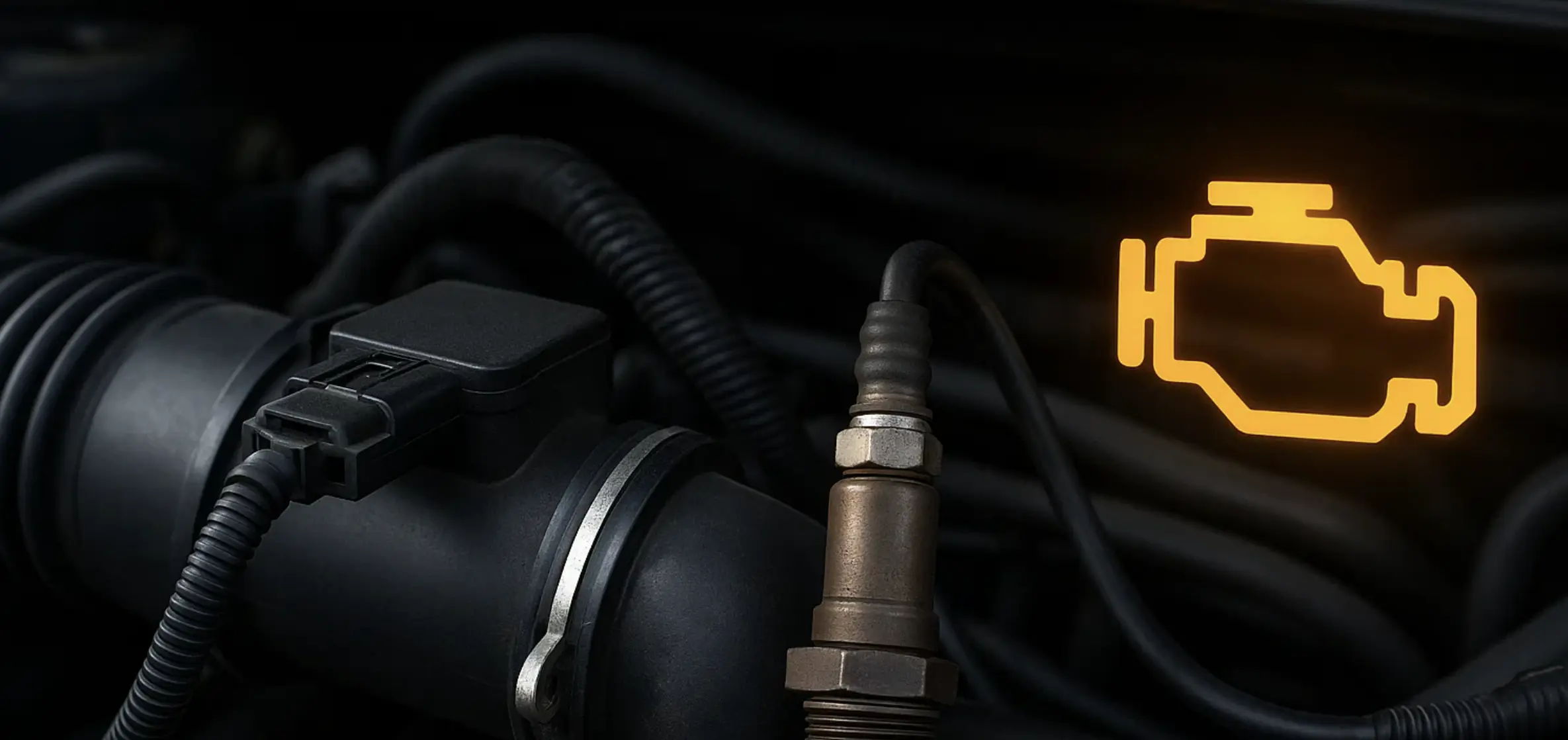
P0171 is a universal OBD-II code that signals a lean running condition on Bank 1, the side of the engine containing cylinder 1. The mixture has too much air and not enough fuel, which hurts performance, fuel economy, and long-term engine health.
This guide gives you clear, practical steps to diagnose and fix P0171. Read slowly and carefully. Follow these instructions, and you’ll get to the root of the problem quickly.
What P0171 Means (Simple Explanation)
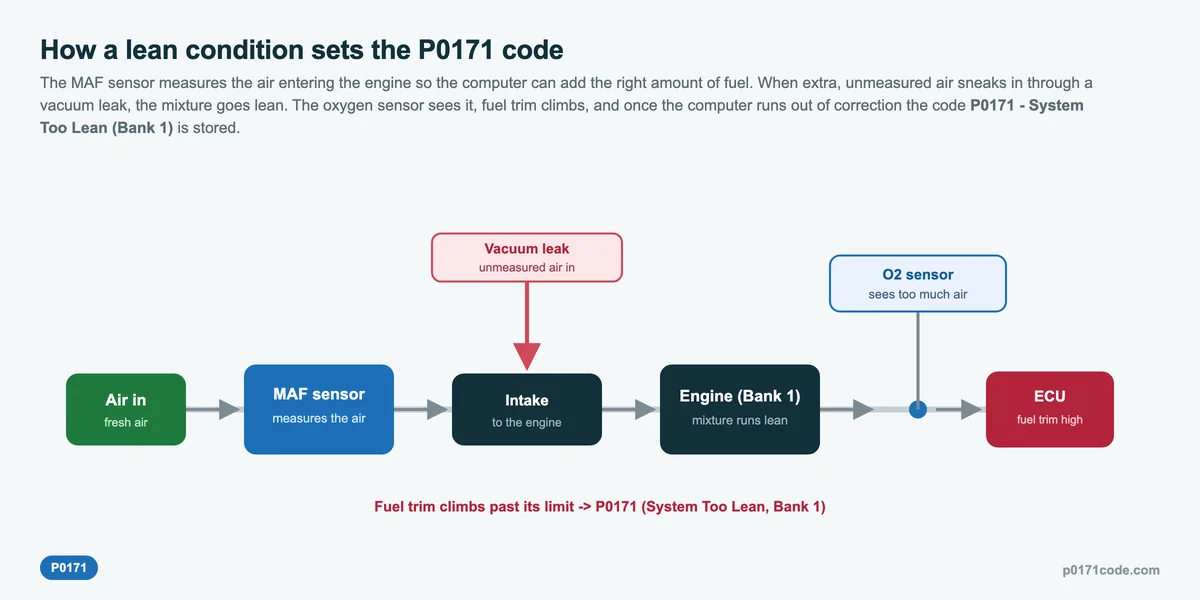
The engine control unit constantly tweaks fuel delivery based on airflow and oxygen sensor readings. When it determines it needs more fuel than normal to keep the mixture balanced, it triggers P0171.
In short:
- Excess air is entering the system.
- The engine is not receiving enough fuel.
Bank 1 refers to the engine side where cylinder 1 is located. Inline engines have only one bank.
Symptoms of P0171
Symptoms vary by vehicle, but most owners will notice some combination of the following:
Common Driving Symptoms
- Rough or unstable idle
- Hesitation or sluggish acceleration
- Loss of power under load
- Increased fuel consumption
- Occasional misfires
- Hard cold starts
- Engine stalling (in severe cases)
- Check Engine Light on (MIL)
Technical Symptoms (Using a Diagnostic Tool)
- LTFT (Long-Term Fuel Trim) consistently above +15% to +25%
- STFT (Short-Term Fuel Trim) elevated at idle or load
- Upstream O2 sensor voltage staying low (lean)
- MAF sensor showing lower airflow than expected
- Idle fluctuations or high idle speed
Most Common Causes of P0171
Here are the most common causes, ranked by how often they actually happen:
1. Vacuum Leaks (Most Common Overall)
Unmetered air sneaking into the engine is the number one cause.
Typical leak points:
- Cracked or loose intake hose/boot
- Damaged PCV hoses or PCV valve stuck open
- Intake manifold gasket leaks
- Broken vacuum tees or connectors
- Leaks around throttle body
- EVAP purge valve stuck open allowing extra air
- Brake booster hose leaks
Why it causes P0171: Air that enters after the MAF sensor goes unmeasured, which forces the mixture lean.
2. Dirty or Faulty MAF Sensor
The MAF sensor measures incoming air. When it gets dirty, it under-reports airflow.
Causes:
- Dust and debris
- Oiled air filters
- Aging sensor electronics
Results:
- ECU injects less fuel than needed
- Fuel trims rise to compensate
3. Weak Fuel Delivery
Anything that reduces fuel volume or pressure will push the engine lean.
Possible reasons:
- Weak fuel pump
- Clogged or restricted fuel filter
- Dirty or partially clogged injectors
- Faulty fuel pressure regulator
- Fuel line restrictions
Clue: The lean condition gets worse under acceleration or load.
4. Faulty Upstream O2 Sensor (Bank 1 Sensor 1)
The upstream oxygen sensor controls the mixture. A slow or biased sensor can falsely report a lean condition even when the engine is running correctly.
Signs:
- Sensor voltage stuck low.
- Switching is slow.
- No proper waveform movement.
5. Exhaust Leaks (Before the O2 Sensor)
Fresh air entering the exhaust stream makes the O2 sensor think the mixture is lean.
Common leak points:
- Crack in the exhaust manifold
- Leak in the manifold gasket
- Loose or missing bolts
6. PCV System Failure
A stuck-open PCV valve or a cracked PCV hose creates a direct vacuum leak into the intake.
How to Diagnose P0171 (Step-by-Step)
Here is a streamlined diagnostic workflow that works on any vehicle.
Step 1 – Scan Fuel Trim Values (Critical First Step)
Use an OBD-II scanner that supports live data.
Normal Ranges
- STFT: – 5% to +5%
- LTFT: – 5% to +10%
Problem Indicators
- LTFT above +15 – 25% → System is adding too much fuel
- STFT elevated at idle only → Vacuum leak
- STFT elevated at load only → Fuel delivery issue
- High trims everywhere → MAF or O2 sensor problem
Step 2 – Check for Vacuum Leaks
Look for:
- Hissing sounds
- Cracked hoses
- Loose clamps
- Intake boot tears
- Worn gaskets
Tools:
- Carb cleaner spray
- Smoke machine
- Soapy water (for turbo systems)
If RPM changes when sprayed → leak found.
Step 3 – Inspect and Clean the MAF Sensor
- Remove the MAF sensor.
- Spray MAF-specific cleaner on the sensor elements.
- Let it dry.
- Reinstall and check the trims again.
If airflow increases after cleaning → MAF was the cause.
Step 4 – Test Fuel Pressure
Use a fuel pressure gauge and compare to manufacturer specifications.
If pressure is:
- Low at idle, the pump or filter is likely the issue.
- Dropping under load, the pump is weak or the filter is clogged.
- Normal but trims stay high, suspect injector problems.
Step 5 – Check O2 Sensor (Upstream)
Signs it’s faulty:
- Voltage stuck low (~0.1 – 0.3V)
- Slow switching
- No active waveform
- Out of expected range
If airflow and fuel pressure are both normal → suspect the O2 sensor.
Step 6 – Inspect Exhaust System
Look for leaks before the upstream O2 sensor.
Any fresh air entering the exhaust will produce false lean readings.
How to Fix P0171 (Practical Solutions)
Here are the most effective and proven fixes.
Use these simple DIY fixes, they’re highly successful.
✔ Clean MAF sensor
One of the fastest and cheapest solutions available.
✔ Fix vacuum leaks
- Replace cracked hoses.
- Tighten loose clamps.
- Replace the intake boot.
- Repair any PCV lines.
✔ Replace PCV valve
A stuck PCV valve directly causes P0171.
✔ Replace air filter
Ensure proper airflow and avoid contamination.
Professional-Level Fixes
✔ Replace upstream O2 sensor
If readings are slow or inaccurate.
✔ Fuel system repairs
- Replace the fuel pump.
- Replace the fuel filter.
- Clean or replace the injectors.
- Repair or replace the regulator.
✔ Intake manifold gasket replacement
Replace it if a smoke test confirms the leak.
✔ Exhaust leak repair
Fix the cracks or replace the manifold gasket.
Quick reference: causes and fixes:
| Cause | How to Confirm | Fix |
|---|---|---|
| Vacuum leak | High trims at idle, hissing noise | Repair hoses/gaskets |
| Dirty MAF | Low airflow readings | Clean or replace MAF |
| Weak fuel delivery | Low pressure | Pump/filter/injectors |
| Faulty O2 sensor | Slow or low voltage | Replace sensor |
| Exhaust leak | Noise near manifold | Repair leak |
| PCV failure | High idle, noise | Replace PCV & hoses |
Confirm the fix with these checks:
After repairs:
- LTFT will drop below +10%.
- Idle will stabilise.
- Acceleration will improve.
- Fuel economy will increase.
- Stalling and hesitation will stop.
If trims stay high, there’s still a leak or fuel delivery problem somewhere in the system.
P0171 is one of the most common lean codes, but it’s also one of the easiest to fix if you take a systematic approach. Checking fuel trims, airflow, and vacuum lines will quickly point you to the root cause.
Frequently Asked Questions
Is it safe to drive with a P0171 code?
For a short time, usually yes if the engine runs normally, but you should fix it soon. A long-term lean condition can raise engine temperatures and damage the catalytic converter.
What is the most common cause of P0171?
A vacuum or intake leak is the most common cause, followed by a dirty or failing mass air flow (MAF) sensor.
Can I fix P0171 myself?
Often yes. Cleaning the MAF sensor, finding a loose vacuum hose, or replacing a bad PCV valve are common DIY fixes. A weak fuel pump or a failed oxygen sensor needs more tools and skill.
How much does it cost to fix P0171?
It ranges from almost nothing (tightening a hose) to about $200 to $600 for a MAF or oxygen sensor, and $400 to $1,000 or more if the fuel pump is at fault.
Will the P0171 code clear itself?
Once the real cause is fixed, the code can clear after several good drive cycles. It will not clear while the lean condition is still present.
Related P0171 Guides
- Fuel trim explained: short-term and long-term
- Vacuum leak symptoms and how to find one
- MAF sensor symptoms and cleaning
- P0174 code: system too lean (Bank 2)
- P0172 code: system too rich (Bank 1)
Sources and Standards
The steps above follow generic OBD-II and fuel-system service practice. For the background and standards, see: